


After a few days in Amsterdam, a day trip to the Dutch countryside can provide a much-needed break from urban buzz. In less than an hour, you can be in Zaanse Schans, a recreated 17th-century Dutch village on the banks of the Zaan River. While somewhat touristy, the free attraction offers a glimpse into the lifestyle of an earlier era that is worlds apart from the capital’s incessant hum.


Although several museums at Zaanse Schans charge for admission, there’s no entry fee to enter the village to view the relocated houses, windmills, storehouses and barns that form a replica of a typical Zaanse village. Alongside windmills, characteristic wooden houses and shops, traditional Dutch crafts are showcased, and the lifestyles of people who lived in Holland long before sex, drugs and rock ‘n’ roll entered the picture are revealed.

Time Flies at the Museum of the Dutch Clock
In a tiny wood-beamed cottage, this collection of working time pieces provides a glimpse into the development of Dutch clocks from 1500‒1850. There’s a small admission fee, but it may be worth it to hear time pieces from Zaandam, The Hague, Amsterdam and Friesland ticking away. The collection traces the evolution from tower and early pendulum clocks to time keepers from Friesland, the Zaanse area and Amsterdam.
A Windmill Turned Oil Mill

Zaanse Schans‘ dazzling windmill collection includes an octagonal platform model that’s been transformed into an oil press. Built around 1693, the De Bonte Hen Mill has been struck by lightning numerous times, but damage was always repaired. After many fires, the windmill is in perfect working order. In a 1973–1978 renovation project, it was refitted as an oil mill.

How a Small Food Emporium Evolved Into a Giant Grocery Chain
Holland’s ubiquitous Albert Heijn grocery chain had modest beginnings as a small food emporium in Oostzaan. Today’s stores with their giant blue and white signs look nothing like the quaint cottage in Zaanse Schans—a reconstruction of the first Albert Heijn and its inventory. In a shop like this, Albert Heijn, grandfather of the mighty Ahold supermarket emporium, opened for business in 1887 when he took over his parents’ small grocery store. The reconstructed interior of his shop reveals changes in the retail food industry over the last century.
Bringing Back Pewter

In a tiny gazebo beside a manicured English garden, an age-old metal craft is practiced. Inside De Tinkoepel Pewter Foundary, a local artisan pours hot pewter into molds, then transforms the molten metal into trinkets, jewelry, trays, mugs and figurines. All are created from an alloy that was so cheap in Colonial days, it was used for bullets in the American Revolution. In the 17th century, the Dutch were renowned for their chiseled pewter works.
Made of tin and lead, pewter is brighter than lead but not as shiny as tin. It wears out faster than hard metals, but has a dark luster as it ages. In the 15th century, it replaced wood for kitchenware. While no famous manufacturers are associated with its use, pewter’s charm reminds many of a bygone era.
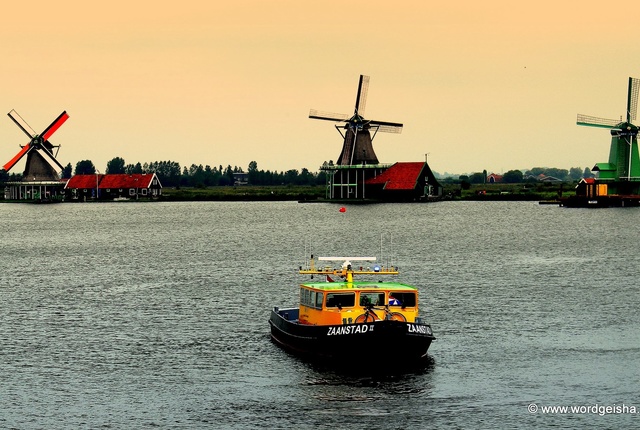
Harnessing the Wind
Long before the Industrial Revolution, companies that relied on wind power grew up on the Zaan River. From cocoa processing to industrial mills, dozens of factories turned out food and paper products, while hundreds of windmills produced power to saw wood from Scandinavia, the Baltics and Germany for ships, homes, mills and warehouses between the 17th‒19th centuries.
Around 1850, steam power supplanted wind, but Zaandam was still a major timber port until the late 20th century. Many villas were built in the late 19th century—evidence of the affluence generated by activities on the Zaan River . Some have been converted into retail or office space, but the windmills and other Golden Age trappings remain at Zaanse Schans.
Zaans Hospitality at D’ Vijf Broers

While Zaanse Schans is less than an hour from Amsterdam by train, you can spend the day there and overnight at D’ Vijf Broers (The Five Brothers) to complete your Zaans experience. The 14-room hotel owned by Sjoerd and Mar Bergsma offers coziness without fuss in a residential neighborhood adjacent to the Zaanse Schans village.

The hotel’s showpiece is a terrace bar overlooking a man-made beach—great for drinks or a meal when weather permits. On upholstered benches set on the sand, watch the sea while nibbling on bitterballen and sipping Moët & Chandon, the house supplier. An 80-seat restaurant serves specialties like Zaanse mosterdsoep in a dining area overlooking the water.